
A Review: My Father's Shadow
NEW YORK, United States — It’s rare to experience a film with very few notes, where in its purity of expression, you reach acceptance of its premise quite quickly. My Father’s Shadow is that film. Directed by Akinola Davies Jr. and co-written with his brother Wale Davies, this single day story details a father and his two sons making their way to Lagos. A believable premise, no doubt, but as the story unfolds and the final scene concludes, the audience is primed to question whether what they even saw for 94 minutes was real. Starring Sope Dirisu and introducing Chibuike Marvellous Egbo and Godwin Egbo, this film is a poignant love story about family — what exists between a husband and a wife, a father and his two sons, and a love of country and statehood. Spoilers abound.
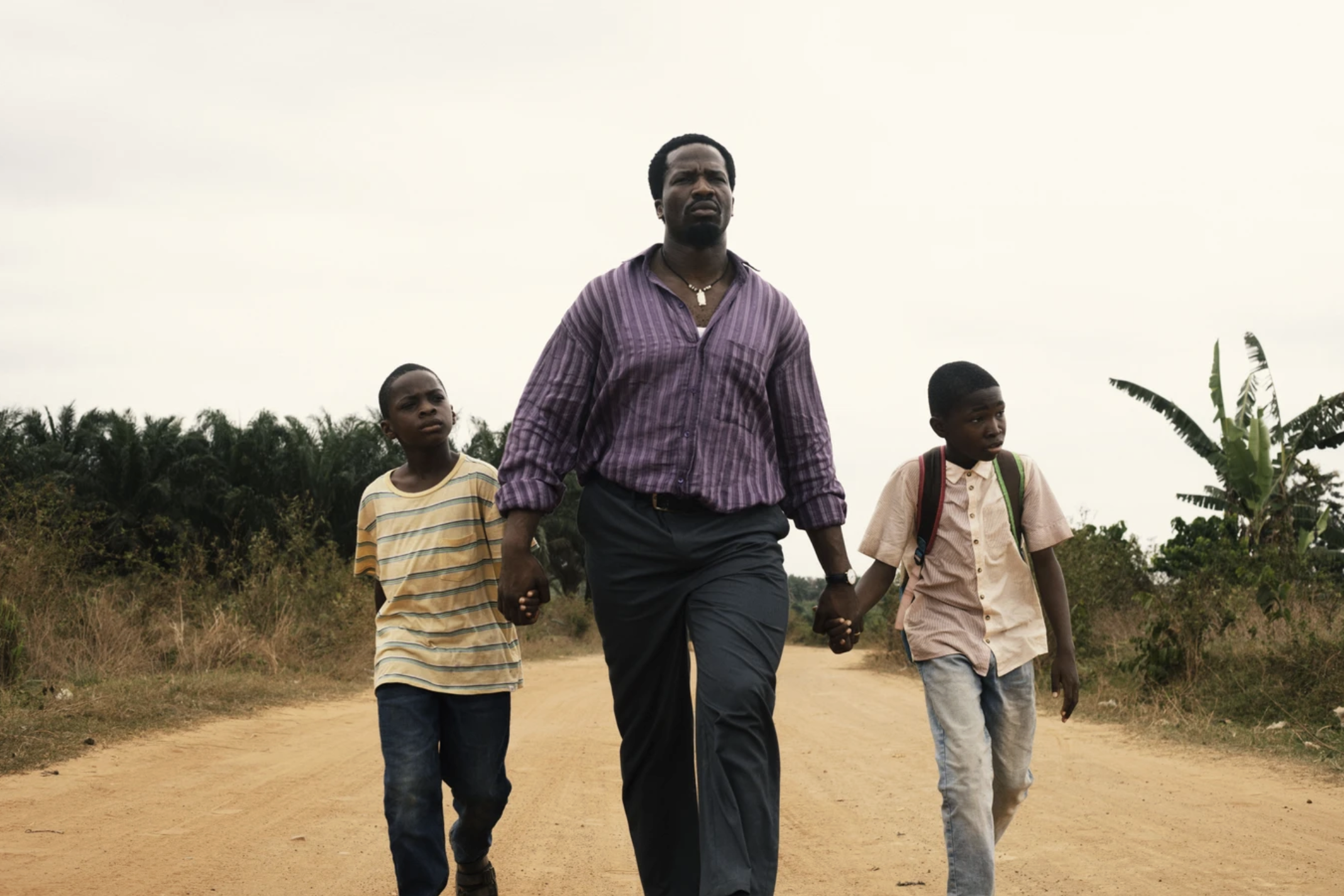
Sope Dirisu as Folarin, Chibuike Marvellous Egbo as Olaremi, and Godwin Egbo as Akinola in My Father’s Shadow
Set in 1993, a father named Folarin decides to take his two sons Olaremi and Akinola on a journey from their village to Lagos. As they walk towards the city and eventually board a bus, they are faced with numerous characters, representing political unease, resource constraint, religious intensity, and capitalism — themes that thread throughout this plot with grim and dire outcomes. As the bus breaks down and they eventually find their way via flatbed truck, they encounter a bustling metropolis full of Folarin’s life, as his work keeps him predominantly away from his family in order to send funds home. Each interaction between Folarin and his past opens up a new portal of intrigue and understanding for his sons, and for the audience, who is learning alongside the boys, just what their father’s absence from them entails. Folarin sees old colleagues, a food seller, a fairground attendant, a lover, and a family friend — all of whom shade a gradient to this complex painting of fatherhood. The momentum of the day is also shaped by the awaiting of the confirmation of election results that will dramatically shape the future of Lagos and the whole of Nigeria. Simple, right?
By the time the election news arrives, the city comes under siege from military opposition and hopes are dashed for a democratically-led nation. A tense brush with an armed guard is haunting as Folarin looked on with disdain to the ever-growing military presence throughout the day’s journey. Now face to face with an officer who thinks he has seen Folarin before, it is as though Folarin has now faced his nation and is asking what will you do with me and what will you do with my sons. Political propaganda and misinformation underline this project: is what we are being told as the audience true? The closing scene ends with a funereal procession of Folarin with his wife and sons in tears. Now, not so simple.
Was it a figment of a child’s imagination? What were the constant references to circling birds overhead? Why the persistent nosebleeds? The intentional choices throughout the film contribute to this disarming pierced veil between dream-like state and harsh reality. Grounding the perspective through the eyes of the child, this depiction of a chaotic journey to Lagos oscillates from playful curiosity and organic humor to palpable danger and the emotional trough of grief without a didactic message in tow. Close-up shots of rotting wood, decaying fruit, and swaying fauna simultaneously imply innocence and something much more ominous impending. An afternoon at a fairground with sweet ice cream immediately invites warm and fuzzy sentiments. A scene of two dogs growling over bones struck a chill down my spine. The knowing of something potentially darker and politically tied around the corner is subtly reinforced by the hushed whispers of adults conferring outside or behind closed doors. So often do we view the young boys leaning against a wall attempting to listen in, an initially unspoken proxy for yearning and a desire for closeness with their naturally elusive father. Who truly knows their parent as a eight year old child? In a later scene, at the beach swimming together, the unspoken disappointment is said out loud and the father’s response is raw, feeling, and despondent.
Shot on 16mm film, the aesthetic indelibly contributes to this uncertainty — from erratic scene shifts fast-paced and then slow to the blurry vintage perspective, it is a masterful weaving of ephemera, the passage of time, and a momentum that suddenly ends like nothing before today mattered at all. The score bounces from lively and naturalistic to lyrical and drum-based, dredging up memory, flashback, and imagination in quick succession. Nothing beats that closing scene: the wailing processional, all of the hopes and dreams of a nation bundled in one body, the intimacy of father and sons, and the veil finally broken.
With its cinematic release last year in Nigeria, the film has since achieved several global recognitions, including 2025 Cannes Film Festival Caméra d'Or Special Distinction, the first Nigerian film to do so. In a recent New York screening held at The Museum of Modern Art in conversation with fashion designer Busayo Olupona, PROTOChic got a taste of Davies Jr.’s perspectives from his intended audience seeing his first feature film to his approach to crafting a story of the imperfect father without judgment.
As for the film’s thoughtful unknowns, Davies Jr reflected on a personal history with his older brother regarding a shared ‘real’ or ‘fabricated’ memory with their own father that they both individually arrived at. Davies Jr is the second son and named after his father. “In the genesis or the kernel in making [My Father’s Shadow], that [shared memory of our father] was the root we laid for the film. We wanted [it] to be that whatever you think it is, if you think it’s a ghost story… if you think it’s a dream… if you think it’s a memory, all of those are welcome. But all that really matters is that those boys had that day with their father.”
“It is really important to speak to the people that we want to speak for.”
He continued, “All of the stories that had always been reflected to us of our father was that he was super charismatic. When we were younger, we would get the PG version and as we grew into older men, we would hear ‘your father was rascal’ laughingly…What we wanted to do with Folarin was take Nigerian fatherhood …or our father off of a pedestal and humanize him.”
In regards to the flattening of African fatherhood, he shared “what happens is [African dads] become very devoid of context as to why they are, the way they are. That is something we really honed into. A lot of the onus [of the film] was to integrate this idea of absence and the idea of an absent father — what does it mean? Some fathers send you to school abroad. Some fathers are abroad sending money back home. There is a tension in that…that maybe sometimes as children, you don’t really understand or get context to. A lot of [the storytelling] was trying to make Folarin feel like a real person.”
As relates to audience reception, he remarked, “another thing was to respect our audience, not to cater [exclusively] to European or American audiences. Our audience is Nigerians, first and foremost, then diaspora second, then the rest of Africa third, and then everyone else is invited. It is really important to speak to the people that we want to speak for. We’re not trying to hold people’s hands through it…if you know, you know… if you don’t, you can find out. That was the impetus.”
My Father’s Shadow is now out in select UK and US cinemas. Trailer via Mubi. Images via Cannes Film Festival.